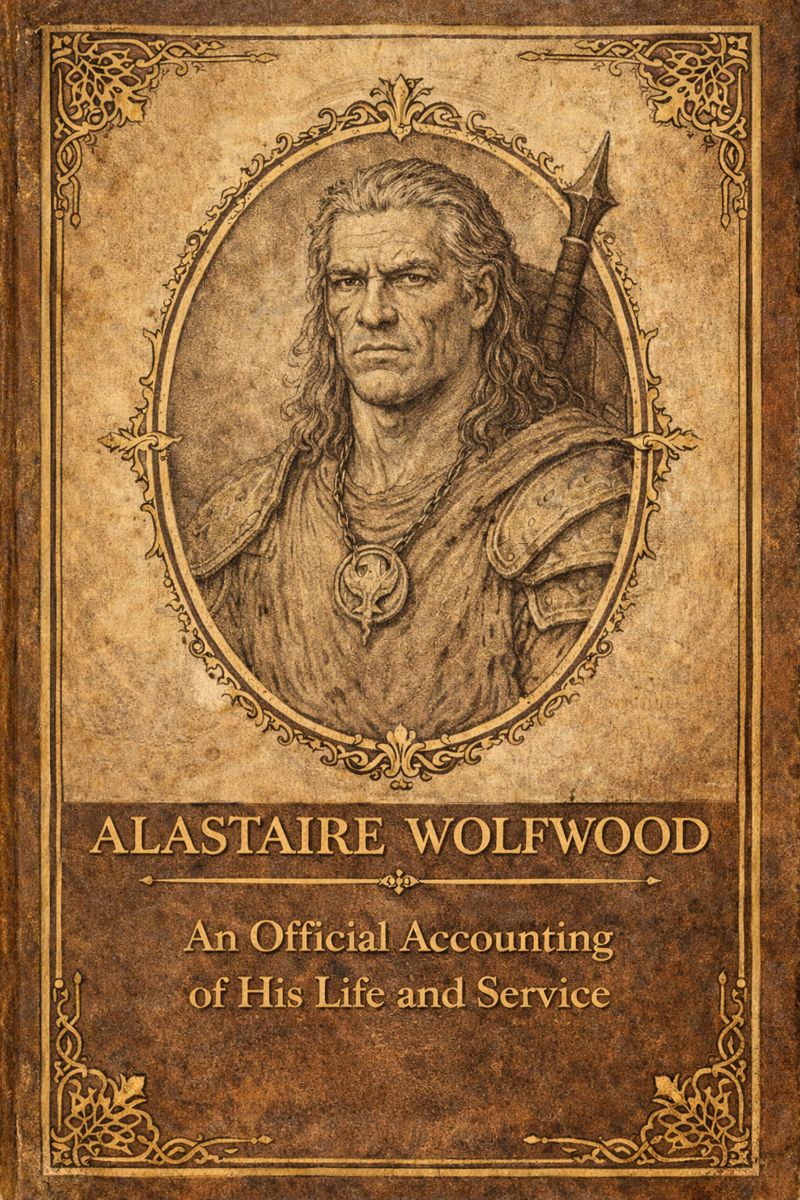

Chapter III — The Final Undertaking
In the years preceding the Second Fall, Alastaire Wolfwood’s actions grew increasingly deliberate and increasingly grave.
Records indicate that during this period, Wolfwood maintained a close and recurring association with Aurora, founder of the Angelstone Cathedral and a central spiritual figure among those who would later be known as the Prevalia Averna. Their connection extended beyond formal councils and recorded engagements; contemporary accounts place them together both in preparation and in the field, advising, traveling, and at times standing side by side during moments of crisis.
Though their methods differed, sources consistently describe a shared understanding between them regarding the nature of the threat posed by the First and the insufficiency of conventional resistance alone.
Where Aurora sought to preserve lives through preparation, faith, and unity, Wolfwood favored confrontation — not out of disregard for others, but from a belief that some costs could be paid once, rather than demanded repeatedly.
Alliance of Purpose
Wolfwood and Aurora are recorded as having met on numerous occasions in the years leading up to the Second Fall. These meetings were neither formal alliances nor public declarations. Their existence is preserved through secondary references in Avernan records, battlefield correspondence, and ecclesiastical summaries.
Wolfwood is characterized in these sources as:
-
Deeply conscious of the toll borne by those who opposed the First
-
Increasingly convinced that delay magnified inevitable loss
-
Unwilling to ask others to endure dangers he would not face himself
Aurora, for her part, is consistently described as the moderating presence — urging endurance, preparation, and shared burden where Wolfwood leaned toward decisive risk.
Observers frequently note that it was in this contrast that their partnership proved strongest.
The Choice to Act
As the influence of the First’s followers expanded and preparations for open conflict became increasingly apparent, Wolfwood appears to have reached a singular conclusion: that waiting would exact a greater cost than action.
Official records suggest that Wolfwood believed:
-
A centralized cult served as a linchpin in the First’s designs
-
Allowing its work to continue unchallenged would doom countless others
-
A direct strike, however perilous, might avert a broader slaughter
This belief marked a turning point in his conduct. Rather than responding to threats as they arose, Wolfwood resolved to carry the conflict directly to its source, seeking to disrupt the First’s designs before they could fully unfold.
Whether this decision was born of strategic foresight, personal conviction, or an enduring pursuit of glory is a matter of ongoing scholarly debate.
Departure from History
Unlike many of his earlier engagements, Wolfwood did not announce his intention, seek reinforcements, or request sanction.
He acted alone.
Military correspondence from the period records Wolfwood declining further assignments, offering only the assurance that:
“There are matters better answered by absence.”
His final movements were reconstructed only indirectly, through reports of travel toward regions later associated with deepening corruption and hostile ritual activity.
The Confrontation
All surviving records agree on the essential facts of Wolfwood’s final undertaking:
-
He infiltrated a site associated with the First’s cult
-
The site housed a powerful necromantic relic tied to the First’s return
-
Wolfwood attempted to destroy or disrupt the relic directly
-
A catastrophic arcane event followed
The site collapsed, rendering its interior inaccessible. Subsequent attempts at entry were abandoned due to lingering instability and pervasive corruption.
Wolfwood did not emerge.
Declaration of Death
With no body recovered and no further confirmed sightings recorded, Alastaire Wolfwood was formally declared deceased.
The absence of remains was attributed to the magnitude of the arcane collapse. No recovery effort succeeded, and no further action was deemed feasible.
Aurora ordered no public memorial. Instead, she redirected her efforts toward the preservation, organization, and preparation of those still willing to stand against the coming Fall.
It is in a private Avernan record from this period that Aurora is attributed the following reflection:
“He understood the price, and decided he would pay it himself.”
Assessment of the Final Act
In official histories, Wolfwood’s final undertaking is variously interpreted.
Some scholars frame it as the culmination of a lifelong pursuit of singular heroism — an act of arrogance born from a belief that he alone could alter the course of fate.
Others contend that it was an act of deliberate sacrifice, undertaken not for glory, but to spare the Prevalia Averna and their allies from being drawn into a war whose cost he believed inevitable.
Both interpretations persist.
What remains uncontested is that Alastaire Wolfwood chose to act when action carried the greatest risk, and that he did so alone.